Chapter 23: Learning to Breathe - Final Draft Ready

There are chapters in a life that do not unfold so much as rupture, and Chapter 23 sits precisely there — in the uneasy space between exhaustion and revelation, between quiet despair and the stubborn, surprising persistence of hope. It is a chapter rooted in Nairobi, though its shadows stretch far beyond it, reaching back into Fangak’s red mud and forward into a Scotland still unseen.
Kacper returns from South Sudan unsteady on his feet, carrying the weight of flooded villages, long nights in leaking huts, and the silent fatigue that follows too much witnessing. Nairobi, with its matatus zig-zagging through fumes, the cafés near Yaya Centre, and the stubborn resilience of everyday life, receives him with familiarity — but not with comfort. His body softens; his confidence thins. He laughs with colleagues, but never quite reaches the laughter itself.
Still, life resumes.
Work regains a rhythm.
The team takes shape around him.
Claire, all calm precision and quiet intelligence, offers a steadiness that makes the office feel less fragile. Nora, bright and expansive, sweeps fatigue from a room simply by entering it. And the newest arrival, Lina — multilingual, outrageous, brilliant — folds into the trio like a missing instrument.
Together they climb the Ngong Hills. They laugh into the wind. For the length of an afternoon, it feels possible to be light again.
But humanitarian normality is always provisional.
The first blow lands with El Wak.
Two Kenyan colleagues — men Kacper had known, laughed with, trusted — are killed on their way home, not on duty, simply living their ordinary day. The news reaches him through tears in Nora’s eyes. The world tilts. Kacper and Nora charter a small plane to the border, crossing the arid land with the hollow knowledge that nothing they do will ever be enough. They sit with mothers and brothers, drink bitter tea, listen to grief that has the texture of dust and age, and promise to remember.
And then — because the field never obeys a single emotional register — the chapter turns to the absurd and the ancient: the fifty cows.
A colleague in Old Fangak is arrested after a foolish mistake involving a married woman. The local commander demands compensation not in money, not in negotiation, but in cattle — the tall-horned river-country cows that carry prestige and pride. What follows is one of the strangest logistical operations of Kacper’s career: hiring a cattle expert, purchasing the right animals in Bor, and organising the perilous two-week march northwards through contested land.
It is farcical, frightening, and somehow beautiful in its own wild logic.
When the cows finally arrive, Commander Lual beams like a triumphant monarch and declares — to Kacper’s astonishment — that anyone is welcome to sleep with his wife so long as they bring equally fine cattle.
It is a moment both ridiculous and real, an anecdote Kacper will later tell with a mixture of disbelief and affection. But comedy does not erase cost. Once the laughter fades, a strange emptiness settles inside him.
And this is where the chapter deepens.
Loneliness — long denied — begins circling him more tightly. Shame grows quiet but sharp. The memory of Rio returns not as longing, but as guilt. He sees his reflection and flinches. Nights stretch. Thoughts acquire edges.
Slowly, softly, he begins imagining an end to his own story.
One evening, when Claire and Nora are out, he locks himself in the annex room. Vodka. Pills. Silence. A long spiral he cannot see his way out of.
By chance — or something that looks very much like grace — the two women turn back after a minor car accident. The guard insists Kacper is inside. They force the door open. The ambulance arrives. The night becomes a blur.
He wakes in Nairobi Hospital — and the chapter offers a quiet echo to long-time readers:
He knew these corridors from another fear, another year.
What follows is one of the most intimate passages in the book.
A Kenyan psychiatrist sits by his bed and simply refuses to leave until Kacper speaks. It takes three days. When words finally break through, they come as tears first, then as the truths he had carried for years — his longing, his shame, the belief that he was unlovable, the quiet ache he had never dared to articulate.
The doctor listens, without flinching, without judgement.
In a country he had feared might reject him, he finds unexpected tenderness — the first person on earth to whom he ever tells the full truth of himself.
It becomes the chapter’s most profound irony and its quiet redemption.
Marc arrives from New York, offering compassion rather than consequences, insisting that GNI stands with him. No punishment. No shame. Only care.
In the end, the decision is made: Kacper will go to a trauma centre in Scotland, a place dedicated to those who have seen too much and carried too heavy a load for too long. He boards a KLM flight — Nairobi to Amsterdam, then onwards to Edinburgh — stepping into the cold Scottish air with fear, relief, and the first faint stirring of a future he had not imagined.
The chapter closes not with triumph, nor with certainty, but with movement.
With breath returning.
With the fragile understanding that survival, too, is a kind of beginning.

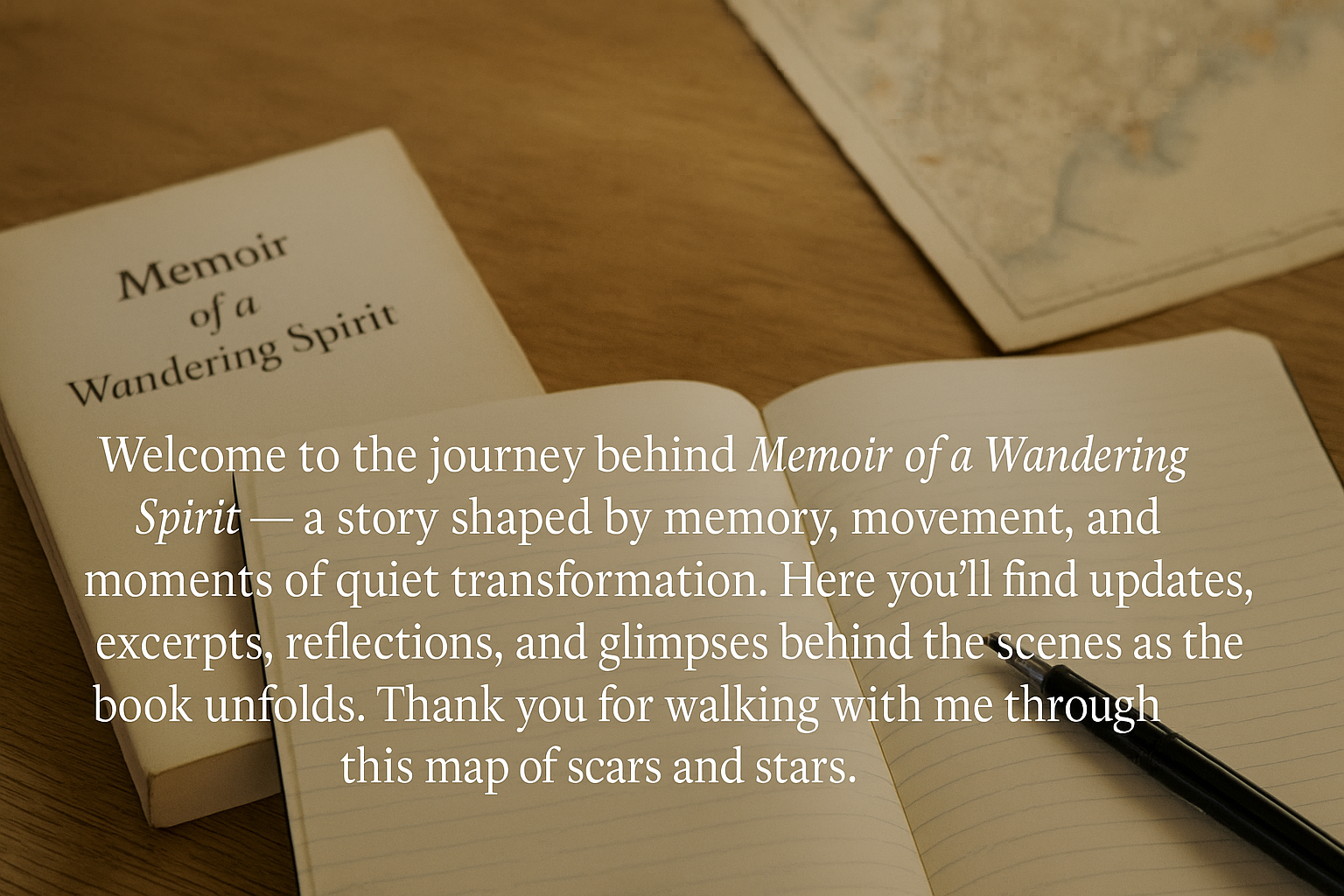
Memoir of a Wandering Spirit
This space is where I’ll share the evolution of a story that has lived inside me for decades — a story of movement, memory, and the quiet weight of becoming. It’s a personal account, yes, but also a collective one — shaped by places, by people, by moments of wonder and fracture.
The memoir weaves through my early life in Poland, years in hospitals and schools that tried to contain me, and the unfolding path that led to war zones, refugee camps, and faraway friendships. From Biegonice to Zakopane, from Kerala to Caracas, from Nowy Sącz to Óbidos — this is a map made of scars and stars.
Here, you’ll find:
• Progress updates on the chapters as I write them
• Extracts from the manuscript
• Stories behind the stories — moments that didn’t make it into the book but still matter
• Photographs from the journey, both literal and emotional
• Occasional reflections on writing, remembering, and telling the truth with care
If you've shared a moment with me along the way — in Poland, Portugal, in the field, in a shelter, on a dusty road — you may find echoes of yourself here, in fictionalised form. Please know that every inclusion is crafted with respect and gratitude.
Thank you for being here.
Thank you for reading.
November 2025
October 2025
September 2025
August 2025
July 2025